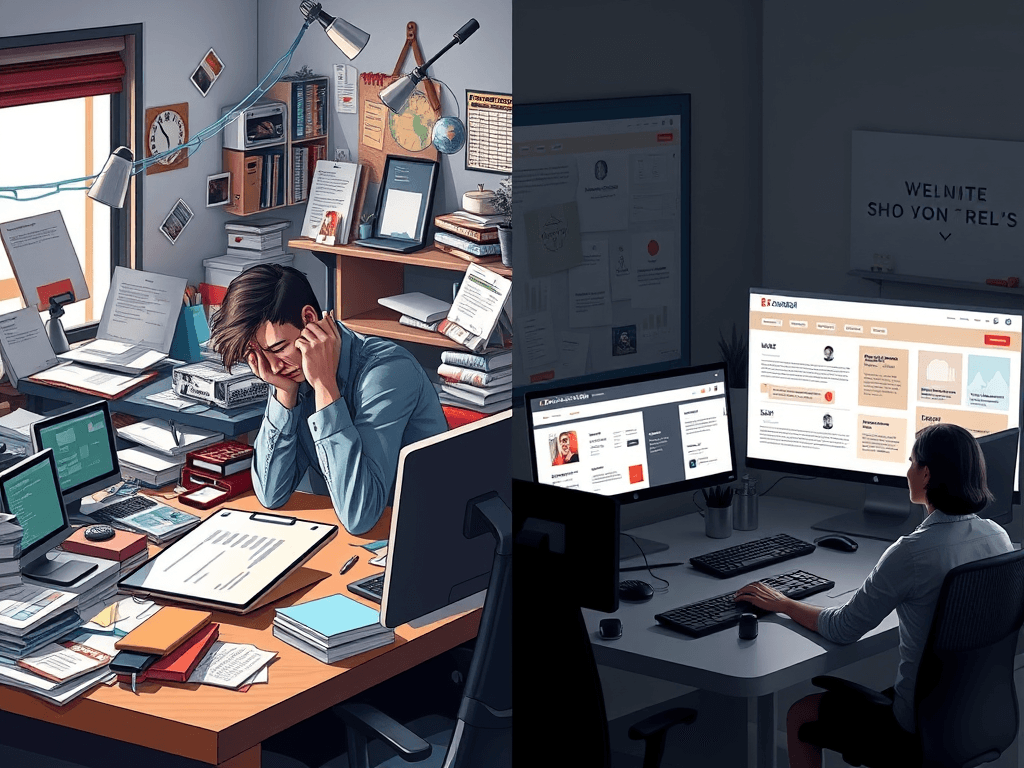
Why drag-and-drop might cost you more in the long run
There’s something empowering about building your own DIY website, but when considering a professional website vs DIY website, it’s crucial to analyse the factors involved in this important decision.
You pick a template, drag a few blocks around, write your tagline in a big bold font, and just like that — ta-da! A DIY website!
Or so it seems…
DIY website builders have exploded in popularity over the last decade. Wix, Squarespace, GoDaddy, Weebly, Shopify — all promising to help anyone build a stunning DIY website with zero coding skills and minimal cost.
Understanding the differences between a professional website vs DIY website is essential for any business looking to grow.
But while drag-and-drop platforms can look good on the surface, what’s underneath often tells a very different story.
In the discussion of professional website vs DIY website, the long-term benefits of a professional site become increasingly apparent.
When considering a professional website vs DIY website, it’s essential to evaluate the long-term benefits that a professionally built site can offer.
When weighing the professional website vs DIY website options, it’s crucial to assess what each can provide for your unique needs.
🏗️ Professional Website vs DIY Website: Understanding the Differences
If you’re serious about your business — and how your DIY website performs, ranks, and converts — there’s a good chance that DIY might not cut it when compared to a professional website vs DIY website approach.
Let’s dig into why.
🛠️ What Exactly Is a DIY Website Builder?
DIY website builders are platforms that let users create DIY websites without writing any code. They provide pre-built themes and elements you can “drag and drop” into place, and they typically include hosting, domain options, and other features in bundled pricing.
Sounds simple, right? And for personal blogs or placeholder pages, DIY websites often are.
But for serious businesses, service providers, ecommerce, or anyone relying on their DIY website to grow, there are real limitations lurking behind the pretty templates.
💰 Upfront Cost vs. Long-Term Investment
Let’s get this out of the way:
Yes, DIY website builders look cheaper up front.
A typical DIY platform might cost:
$20–$40/month for basic features
$60+/month for ecommerce or added functionality
More if you add email marketing, booking systems, or SEO tools
But those costs add up quickly. And more importantly — they don’t tell the full story.
Here’s what you don’t get with a DIY build:
Custom integrations with your business systems
Control over hosting performance and backups
Optimised SEO from the ground up
Scalability for future growth
Hands-on strategy and support
A team that knows your business, not a chatbot
A professionally built DIY website isn’t just a cost — it’s a business asset. One that pays you back through faster load times, better rankings, higher conversions, and fewer rebuilds down the line.
📉 The Hidden Costs of DIY
Let’s talk about the costs nobody tells you about when you use a DIY platform:
1. Time
Even with drag-and-drop tools, building a decent-looking DIY website takes time — and time is money. Every hour you spend fiddling with fonts, resizing images, or trying to figure out why your mobile version looks like a Picasso painting… is time you’re not spending on your actual business.
2. Limitations
Deciding on a professional website vs DIY website approach can significantly impact your online presence and business success.
Most builders offer limited control over:
Exploring the professional website vs DIY website debate reveals insights about cost, efficiency, and effectiveness.
SEO structure
URL formatting
Page speed optimisation
Schema markup
Server location and configuration
Custom integrations
These limitations can severely hurt your search rankings, site performance, and future growth.
Time spent on a DIY website often highlights the contrasts in the professional website vs DIY website discussion.
3. Design Restrictions
Sure, templates look great — until your brand doesn’t quite fit. Suddenly you’re forcing your business into a layout that was never designed for it.
4. Vendor Lock-In
Your content, design, and structure are often trapped in their system. Want to migrate to WordPress later? Good luck extracting your DIY website without rebuilding from scratch.
🧑💻 What You Get With a Professional Build
At Bitstream Media, we build DIY websites that don’t just look good — they actually work. For your business, your users, your IT systems, and your future plans.
Here’s what sets a professional build apart:
✅ Tailored Strategy
We don’t start with a theme — we start with you. Your business goals, your customers, your voice, your niche. Then we build a DIY website to match.
✅ Technical Foundation
We understand DNS, email systems, hosting performance, CDNs, SSL, caching, and SEO structure — all the nerdy stuff DIY platforms gloss over.
Knowing the limitations of a DIY website is vital when considering the professional website vs DIY website options.
✅ Future-Proofing
Need to scale? Launch a new service? Add bookings, memberships, gated content? No problem. Our builds are made to grow with you.
✅ Performance
Our DIY websites are fast, optimised, and built to shine on Core Web Vitals — not chug along at 7 seconds per page load.
✅ SEO-Ready
We bake SEO into the foundation. Clean code, structured content, schema markup, logical headings, and fast performance — Google loves it.
✅ Real Support
Got a problem? You’re talking to a real human who knows your business — not a chatbot named “Supportly McSupportface.”
🚫 Common Problems DIY Builders Can’t Solve
Even the best DIY platforms can’t fix these:
❌ Clashing With Other Tech
Your email system, CRM, payment gateway, analytics stack — DIY builders often don’t play well with them.
❌ Poor Mobile Optimisation
Mobile traffic now accounts for more than half of all web visits. Many DIY templates still perform poorly on smaller screens, and editing mobile layouts manually is a nightmare.
❌ Limited SEO Tools
Some builders let you add meta tags — but that’s barely scratching the surface of what real SEO needs.
❌ One Size Fits… No One?
Templates aren’t tailored for you. That means compromises in design, content structure, and user experience — all of which affect conversions.
🔍 Real Talk: DIY Is Fine for Some… But Risky for Growth
There’s nothing wrong with starting small. DIY tools are fine if:
You’re launching a side hobby or personal blog
You just need a placeholder while your real DIY website is built
Your business isn’t reliant on the internet
But if your DIY website is a core part of your business — if it’s how customers find, contact, or purchase from you — then DIY becomes a risk.
And at Bitstream, we’ve rebuilt plenty of DIY websites that started out “good enough” on DIY platforms… until they weren’t.
🧠 Case Study: The Drag-and-Drop Regret
One of our clients came to us after spending 6 months on a DIY builder. The site looked okay, but:
It ranked poorly on Google
Mobile layout was broken
Site speed was over 5 seconds
Bookings weren’t syncing with their calendar
Their email domain got flagged because it was misconfigured
They thought they were saving money. In the end, they paid twice: once to build it themselves, and again to have it done right.
Now? Their Bitstream-built DIY website ranks on page 1, loads in under 2 seconds, and gets more enquiries in a week than the old DIY website got in a month.
As you explore the professional website vs DIY website paths, remember the potential pitfalls of each choice.
🧰 What About WordPress? Isn’t That DIY Too?
Not quite.
WordPress can be DIY, but in the right hands it’s a powerful, flexible, professional-grade platform for building your DIY website.
At Bitstream Media:
We customise WordPress beyond themes
We integrate it into your business stack
We optimise it for speed, SEO, and security
And we hand over an admin area that’s actually usable
Your choice of professional website vs DIY website could either elevate or hinder your online presence.
In summary, weigh the options of professional website vs DIY website carefully for optimal results.
By understanding the nuances of professional website vs DIY website, you can make a choice that aligns with your vision.
Ultimately, the professional website vs DIY website debate can redefine your approach to online business.
As you navigate the professional website vs DIY website terrain, remember the long-term consequences of your choice.
The choice between a professional website vs DIY website ultimately impacts your brand’s online identity.
In conclusion, evaluating the professional website vs DIY website options can lead to a more informed decision.
Your journey in the professional website vs DIY website landscape will influence your growth trajectory.
Ultimately, the professional website vs DIY website dilemma can shape your online success story.
Both choices, professional website vs DIY website, carry their own set of advantages and disadvantages.
From user experience to SEO, understanding the professional website vs DIY website distinction is crucial for success.
Investing in a professional website vs DIY website can lead to greater returns in the long run.
Ultimately, the decision of professional website vs DIY website comes down to your business objectives and resources.
The professional website vs DIY website choice directly correlates with your brand’s ability to thrive in a competitive landscape.
It’s the best of both worlds: control for you, power under the hood for your DIY website.
🧮 The Value of a DIY Website That Works
Let’s say your DIY website gets 1,000 visitors per month.
A slow, clunky, poorly structured DIY website might convert 1%.
That’s 10 leads.
A fast, optimised, strategic DIY website might convert 3–5%.
That’s 30–50 leads — every month.
Even if your product is $100, that’s a difference of $2,000–$4,000/month.
That’s the ROI of doing your DIY website right.
🚀 TL;DR: DIY Looks Cheap — Until It Isn’t
DIY Website Builders:
✅ Fast to launch
✅ Low upfront cost
❌ Limited control
❌ Poor SEO
❌ Not scalable
❌ Hard to migrate
❌ Generic design
❌ Hidden time and tech costs
Professional Builds (Like Bitstream Media):
✅ Custom to your brand
✅ Optimised for SEO, speed, and accessibility
✅ Scalable, flexible, future-proof
✅ Integrated with your tech
✅ Backed by real-world support
✅ Designed to convert
If your DIY website is more than just a business card — if it’s a key part of how you attract, engage, and convert customers — then a professional build isn’t an expense. It’s a smart investment.
✋ Ready to Move Past DIY?
If you’re tired of limitations, lag, or lack of results — we’re here.
🌐 Visit bitstreammedia.com.au
Let’s build a DIY website that’s worth more than the sum of its templates.